
There were three plates of the fivepence second pictorial: numbered 1, 2 and 3 with the issued sheets having 120 stamps in 10 rows of 12. Stamps printed from plate 2 appeared in 1942. The first printing was by De La Rue, but due to Blitz damage to De La Rue's works, the sheets were sent to Waterlow where they were perforated 12½.
In November 1942, stamps from plates 1 and 2 appeared printed and perforated 13¾x13½ by De La Rue. Stamps printed from plate 3 were issued in 1944.
Fivepence plate 1
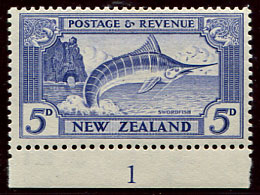
The first issue on 1 May 1935 was on single watermarked paper perf 13-14x13½. Stamps then appeared perf 13½x14. In August 1936 stamps were issued on multiple watermarked paper in both perforations 13-14x13½ and 14-13x13½.
Blitz perforations printed by Waterlow
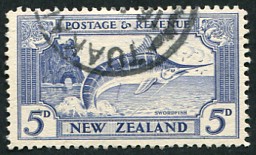
After the bombing damage to De la Rue's premises, plate 1 was handed over to Waterlow in late 1940 and in February 1941, an order of 21,000 were printed and perforated 12½ by Waterlow on a fine paper. They were in a pale ultramarine as can be seen in the example on the right. They were issued in July 1941.
Blitz perforations printed by De La Rue
Plate 1 was returned to De La Rue in September 1941. In December, sheets were printed by De La Rue on a coarse paper, but sent to Waterlow where they were perforated 12½. A small number of these sheets were from plate 1. They were issued in 1942.
Later in 1942, stamps from plate 1 were issued on coarse paper and perforated 13¾x13½
Fivepence plate 2
Blitz perforations printed by De La Rue
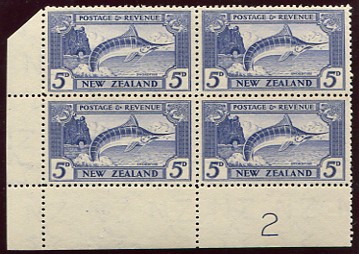
Stamps from plate 2 were printed by De La Rue on coarse paper. The first stamps formed the bulk of the sheets sent to Waterlow in December 1941 and perforated 12½. They were issued in 1942.
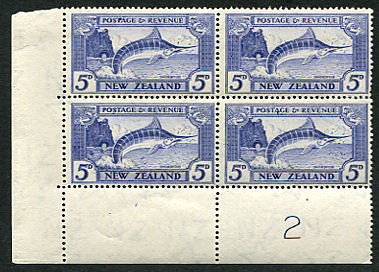
The line characteristics are clearly seen in the plate block on the right.
Printed and perforated by De La Rue
In November 1942, stamps were issued printed and perforated 13¾x13½ by De La Rue.
The stamps perforated 13¾x13½ exist with the direction of the perforation top to bottom (perforation exending through bottom selvedge) and bottom to top (perforation extending through bottom selvedge). Both the plate blocks shown are top to bottom. Different 13¾x13½ comb heads were used giving a different alignment of perforation holes [1]. The alignment can clearly be seen to be different in the two plate blocks below.
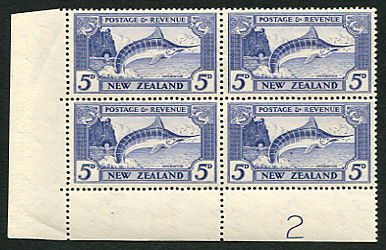
Pitting of the plate
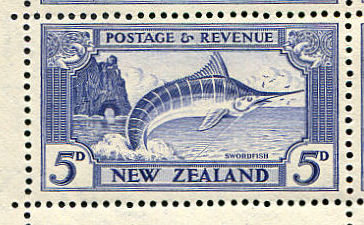
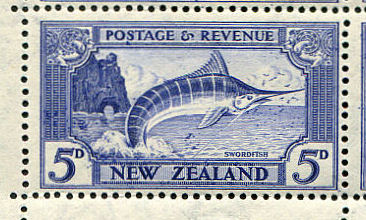
The fivepence plate 2 is of special interest as
the plate deteriorated during use and became pitted resulting
in spots appearing on the issued stamps.
As an example the scans show the bottom left stamp before and after pitting occurred.
In this example, the pitting is mostly below the swordfish.
Progressive Development of Flaws
In addition, various flaws progressively developed at certain positions in the plate.
Two examples are the impressions at positions Row 9/1 and 10/2. There are no flaws in the printings perforated 12½, but at R10/2, a flaw to the left of E of ZEALAND exists even in early printings perforated 13¾x13½.
During the printings perforated 13¾x13½, the T of POSTAGE at R9/1, became progressively more deformed. Later, at R10/2, a flaw developed on the A of POSTAGE.
As a plate block of 4, contains the stamps at positions 9/1, 9/2,
10/1 and 10/2,
positional blocks are readily available.
However, I have not found any reference to these flaws and
their different states in the literature.
I have blocks in each of the following states.


Perf 12½ no flaws:
In the issue perf 12½., there is no
flaw on the T at R9/1 or on either the E or
A at R10/2.



E flaw, trace of T flaw, but no A flaw: Early printing perf 13¾x13½,
beginning of the T flaw on R9/1,
while on R10/2, the flaw to the left of E is clear, but there is no A flaw.



E flaw, T flaw pronounced, still no A flaw: Much more developed
T flaw in POSTAGE on R9/1,
but the A flaw on R10/2 is still not present while E flaw is unchanged.



Spotted plate with all three flaws: Severe spotting developed on the plate.
The T flaw in POSTAGE on R9/1
became much more pronounced and the A flaw in POSTAGE
on R10/2 appeared.





Spots removed, but the flaws remain: The spotting on the plates was subsequently removed, but the flaws on E, T and A remained although the flaw to the left of E is smaller.
In addition, the impressions at R9/1 and R10/1 were re-entered. In the comparison of the bottom right corner of the original and the re-entered states of R9/1, note the doubling that has occurred.
One question remains; the impression at R9/1 has been re-entered, so why does
the flaw on the T remain?
Is it because the flaw is due to the surface of the plate being pitted
and re-entering the image has not changed that?
Fivepence plate 3
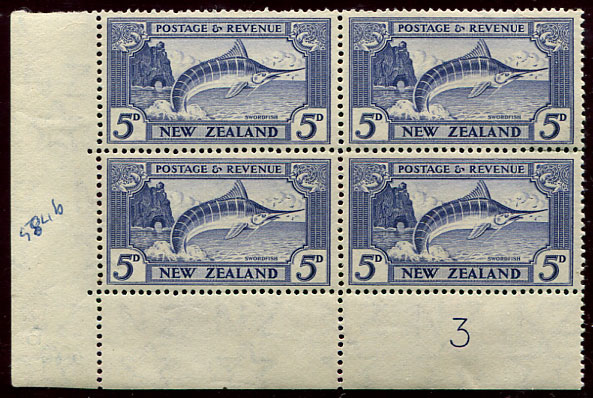
Stamps from plate 3 were first issued in April 1944.
They were perforated 13¾x13½.
The 5d was withdrawn on 30 April 1947.


back next
Background information on the 5d is taken from The Postage Stamps of New Zealand Vol 2, published by the Royal Philatelic Society of New Zealand in 1950. All scans were made by the author. [1] Rickards, G, The Four Perforating Heads used by De la Rue & Co. on New Zealand 1942 2½, 5d, 2s and 3s Pictorials, The New Zealand Stamp Collector, vol 93, pp 45-53, June 2013.