New Zealand fiscal and postage stamps were overprinted for various revenue purposes. Some are given below.
Counterpart
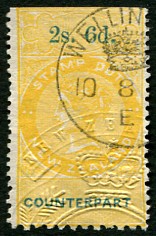
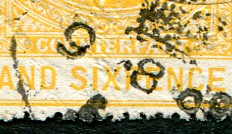
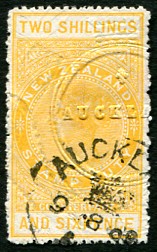
Counterpart stamps were attached to duplicate (i.e. counterpart) documents provided that the full stamp duty had been paid on the original. The counterpart fee was 2s 6d.
The first issue was in 1870 and the design was Die I of the 1867 Revenue issue. The stamp on the left is Die II and was issued in 1880.
In 1887, stamps were issued in the design of the revenue stamps
of 1880, but with the word Counterpart in rather small letters
above the value as in the example on the right.
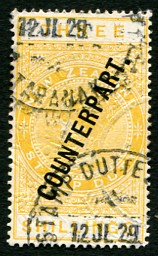
In 1916 the fee was increased to 3s 0d and ordinary revenue stamps were overprinted diagonally in black although special printings were made as the colour was always yellow. It exists both perf 14 and perf 14½x14.
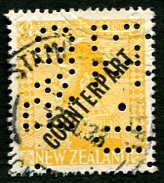
In 1927, the George V 3s 0d Admiral stamp was printed on Cowan paper, perf 14, in orange yellow and overprinted diagonally in black. As with all these stamps, the colour means that the design does not stand out clearly.
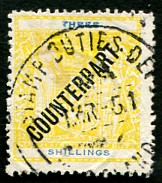
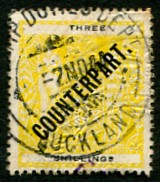
Subsequently, the Coat of arms revenue issue of 1931 was printed in lemon yellow and overprinted diagonally in black. The Three Shillings value was first in black and then later in blue.
Denoting
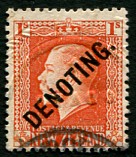
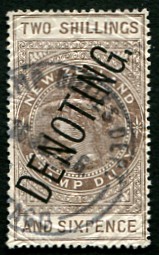
Apparently, when stamp duty had to be paid, the first document had stamps for the full amount while subsequent documents for the same transaction just carried a single stamp to denote that the stamp duty had already been paid.
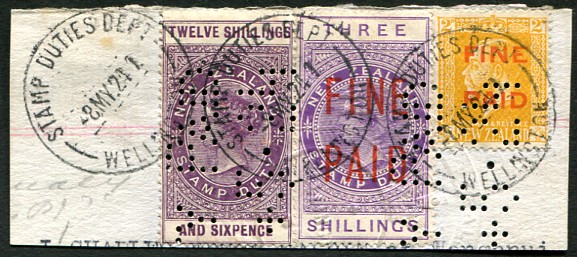
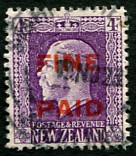
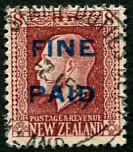
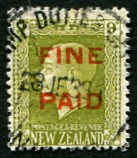
Such overprints first appeared in 1922 on George V 3d, 1/-
and 3/- stamps.
Later issues were on 2/6 and 12/6 long type fiscals, on 1/3 and 3/-
arms type fiscals and on the 3d, 6d and 1/- second pictorials.
Fine Paid
The fine was for late payment of stamp duty. From 1867 until 1922, fiscal stamps were inscribed Fine Paid with separate fiscal stamps for the required value being added to the document.
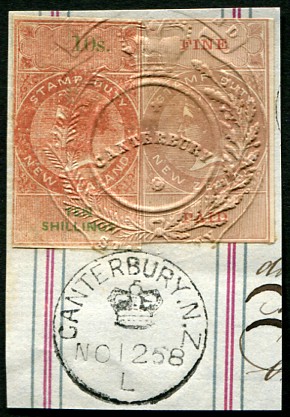
The first issue was in 1867 in the design of Die I of the 1867 revenue issue. It was originally imperforate with the background colour in grey brown and the inscription in red. The example is in combination with an imperforate fiscal 10s 0d giving the value of the fine and is dated 1868.
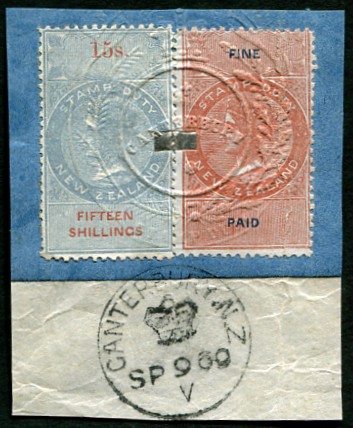
In 1868 it was issued perforated 12½ with the background colour in red brown and the inscription in blue.
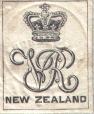
The second example is dated 1869 and shows the 1868 Fine Paid issue together with a 15s 0d revenue stamp. The two stamps are joined by a metal foil tie and there is a VR Crown label on the back of the document.
From 1873, the stamps were Die II with the inscription in blue.
Long Type Fiscals
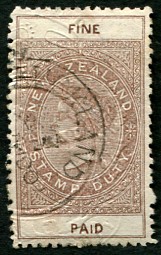
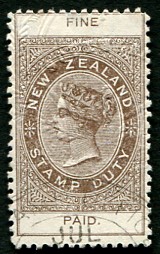
No dot and dot
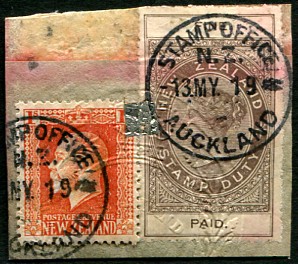
Later issues were on the long type fiscals. The 1882 issue had no stop after Paid, was pale brown and was perf 'nearly 12'. Later stamps had a stop after Paid. In 1894 the stamps were perf 12½ and in 1897 perf 11 in a deep brown. In 1914, the perf was changed to 14 and the colour was grey brown.
Until 1922 documents continued to have
the amount of the fine on a separate stamp.
It was often joined to the Fine Paid
stamp by a metal foil tie.
The example is dated 1918.
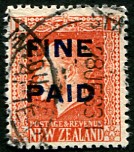
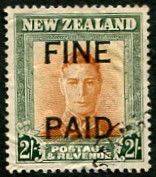
After 1922, ordinary postage or revenue stamps were overprinted and so there was no longer any need for special stamps.
George V
George VI
Mortgagee's Indemnity Fee
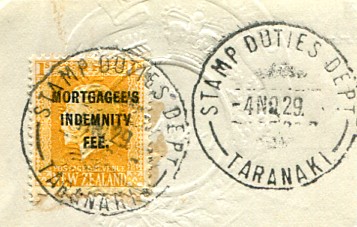
This was a fixed payment of 1s 0d on all mortgages between 1927 and 1950. It went towards a fund to cover compensation for workers injured on the premises.
The first issue was the George V recess printed 1s 0d overprinted on three lines. As well as overprints on the normal George V recess printed stamps, some were specially printed in yellow as in the example shown.
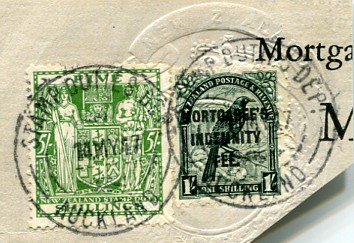
The 1s 0d 1935 pictorial definitive was also overprinted as was the George VI definitive 1s 0d value.
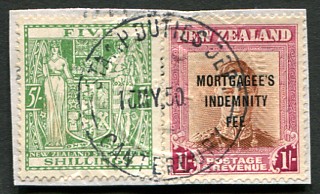
As the pictorial and GVI examples are tied with a 5s 0d fiscal, this suggests that the fee had been raised to 6s 0d.
A change in the law meant that these stamps were no longer required after 1 December 1950.
Not Liable
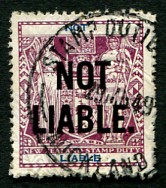
These stamps were attached to documents to show that they were not liable for stamp duty. They were in the same design as the ordinary duty stamps, with NOT LIABLE replacing the value.
From 1875 until 1882, the design was that of the 1867 revenue stamps
and the colour was lilac and green.
From 1882 until 1931, they were in the design of the 1880 revenue
stamps and were in shades of purple.
Finally, the Arms design was used and the colour was purple
while NOT LIABLE was both overprinted in black and printed in
blue.


back next
The above information is taken from The Postage Stamps of New Zealand Vol 6, published by the Royal Philatelic Society of New Zealand in 1977. All scans were made by the author.