The initial issue on 1 May 1935 was on paper with a single watermark and vertical mesh. The plates of 480 each had two panes (A and B) and the stamps printed from each pane were in 10 horizontal rows of 24. The printed sheets of 480 were divided in two before perforation.
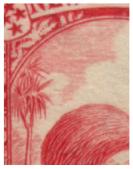
Die 3
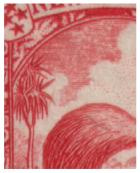
Die 2
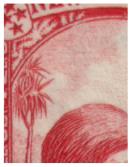
Die 1
Later in 1935, there was a small issue perf 13½x14.
A special plate was produced to make booklets and the stamps were issued in November 1935.
In April 1936, stamps were issued on multiple watermarked paper with a horizontal mesh.
Three different dies were used. They differ in the strength of the lines in the clouds.
Die 1 was used in plates 1 and 2.
The second die was used in the special booklet plate.
Die 3 was was used in plates 3 and 4.
Die 1
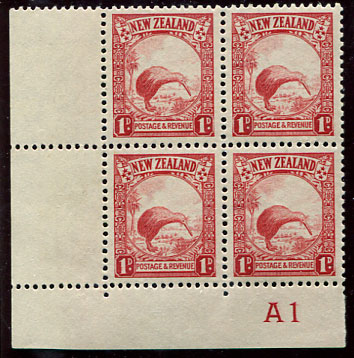
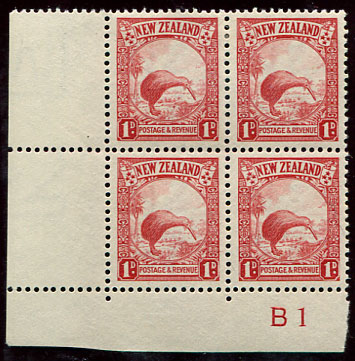
The initial issue on 1 May 1935 was on paper with a single watermark.
The first plate had pane numbers A1 and B1 and the second plate had pane numbers A2 and B2. The number is under the second stamp in the bottom row.
The stamps were from die 1 in which the lines of the clouds are not well defined.
They were perforated 14x13½ and in both the shown blocks the perforation is from right to left.
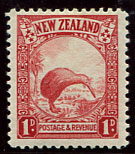
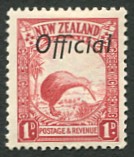
Later in 1935, there was a small issue perf 13½x14 from pane B2. These stamps have line perf characteristics as seen in the example on the right.
Stamps from all four panes perf 14x13½ were overprinted Official and issued
in March 1936 together with a small number perf 13½x14.
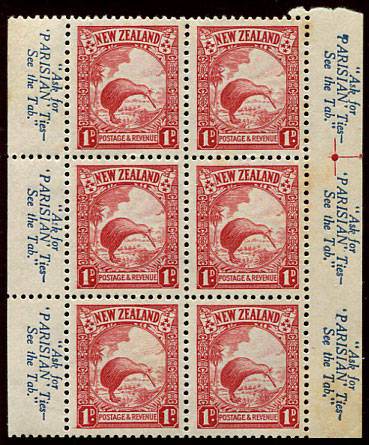
Die 2
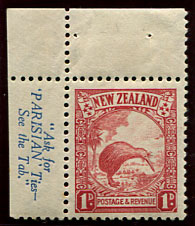
A special plate containing 144 impressions was produced to make booklets and the stamps were issued on 18 November 1935 on single watermarked paper. The stamps are from die 2 and the lines in the clouds are much stronger than before.
The booklet panes had Parisian Tie adverts in the margins.
The plate was laid out so that there were 3 rows each of 8 booklet panes. The middle row was inverted and so one third of the issued stamps have an inverted watermark.
The number of booklets produced was 214,800.
Each booklet had 24 stamps.
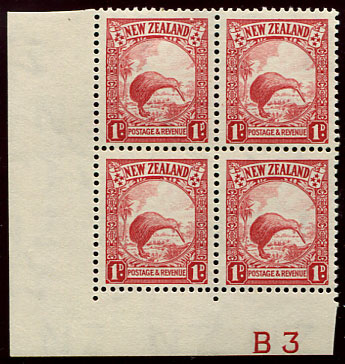
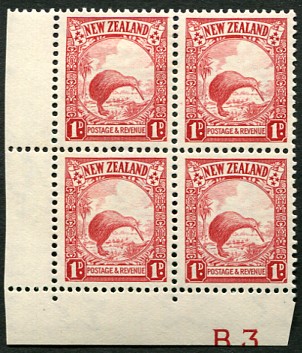
Die 3
In April 1936, stamps were issued on multiple watermarked paper from a third plate with pane numbers A3 and B3 and in August from a fourth plate with pane numbers A4 and B4.
A third die was used with these plates. The strength of the lines in the clouds is intermediate between dies 1 and 2.
In the shown blocks, B3 is shown with both perforations from left to right and from right to left.
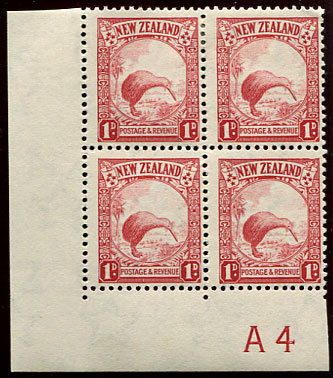
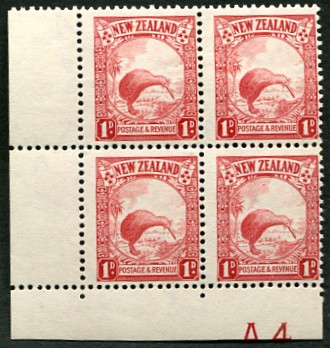
A4 blocks are shown with both perforations from left to right and from right to left.
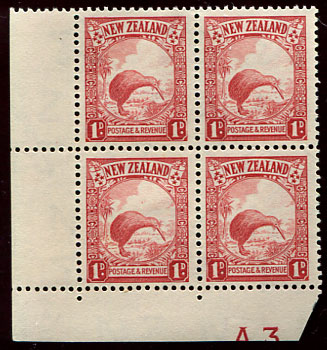
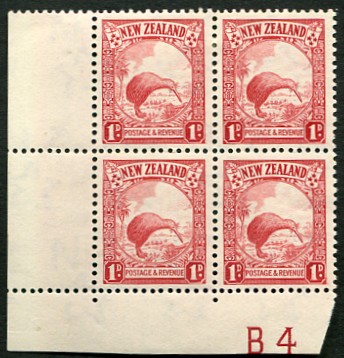
In the shown blocks, both A3 and B4 are perforforated right to left.
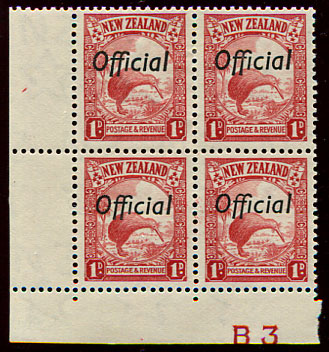
Official
Printings from plates B3 and B4 overprinted Official were issued in October 1936 while printings overprinted Official from A4 appeared in January and from A3 in February 1937.
The shown block is perforated right to left.
New Booklets
New booklets were issued in November 1936 with the impressions from die 3.
The new booklet plate had 180 impressions. The 30 panes in the plate were organised in 6 columns of 5 panes. There were gaps between the columns that were used to produced the binding selvedge in the booklets.
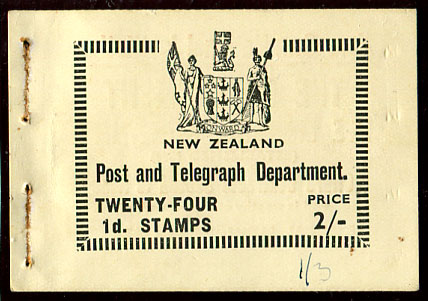
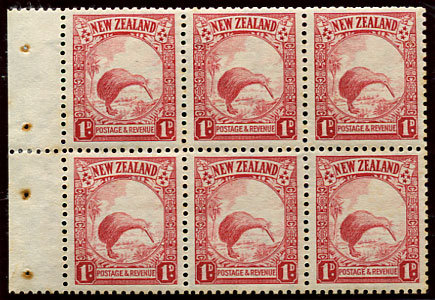
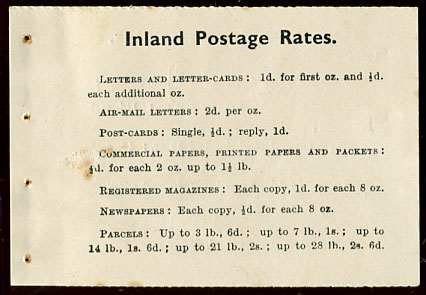
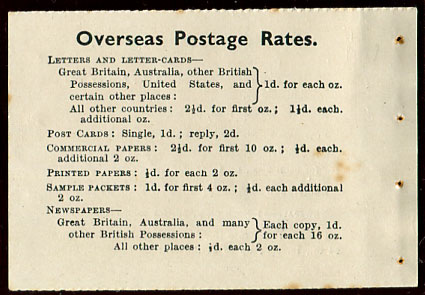
Each booklet had 24 stamps. The booklets had pages, printed on both sides, of adverts for the Government State Fire and Accident Insurance Office and for the Government Life Insurance Department interleaving the four panes of stamps together with two sides describing the current postal rates. The postal rates pages are reproduced here.
The 1d was replaced by the George VI definitive on 1 July 1938.


back next
The above information is taken from The Postage Stamps of New Zealand Vol 1 published by the Royal Philatelic Society of New Zealand in 1938, 1950 and 1964. All scans were made by the author.